




AI
How Consumers Use ChatGPT + Google AI to Discover, Compare, and Buy Retail Products

Published: March 11, 2026
Share on LinkedIn Share on Twitter Share on Facebook Click to print Click to copy url

AI is fundamentally changing consumer shopping behavior by moving decision-making upstream—compressing discovery and comparison into a single conversational interface. Instead of jumping between search results, marketplaces, reviews, and retailer sites, shoppers now ask ChatGPT or Google AI a constraint-rich question (“under $150,” “for small spaces,” “best for beginners”) and get a structured shortlist before they ever click. That shift rewrites visibility: it’s no longer just about ranking on a SERP—it’s about being included in the AI-generated answer set that becomes the shopper’s first consideration list.
Key Takeaways
- How is AI fundamentally changing consumer shopping behavior? AI is moving decision-making upstream by compressing discovery and comparison into a single conversational interface. Instead of browsing across multiple sites, consumers generate constraint-rich prompts and receive structured shortlists before ever reaching a retailer. Visibility is shifting from ranking in search results to appearing inside AI-generated answer sets.
- Why are consumers adopting AI for shopping so rapidly? Adoption is driven by effort expectancy, the perceived ease of use. Consumers use AI because it reduces friction, simplifies tradeoffs, and accelerates price comparison. When AI consistently saves time and mental effort, it becomes embedded in the default research workflow.
- What is the most important new performance metric in AI-mediated commerce? The critical metric is AI Inclusion Rate, the percentage of high-intent prompts where a brand or SKU appears in a synthesized response. Inclusion now precedes traffic and conversion. Retailers that optimize structured data and semantic clarity increase their probability of being shortlisted.
- Does AI eliminate the need for retailer websites? No, it reframes their role. AI increasingly generates shortlists, but retailer sites remain essential for validation, trust reinforcement, and transaction completion. AI drives consideration; retailers must convert high-intent traffic efficiently.
- What separates retailers who capture AI-driven value from those who struggle? The differentiator is operational integration. Retailers that embed AI into workflows, structured data systems, governance models, and measurement frameworks outperform those that treat AI as a surface-level tool.
The AI Shopping Shift in 2026
AI-assisted shopping has moved from “interesting” to habitual. As detailed in the consumer benchmark research on generative AI shopping behavior, generative AI tools are no longer treated as occasional novelty utilities; they are becoming default companions for shopping research, comparison, and shortlisting. This matters because the location of shopping cognition is shifting: a growing portion of the purchase journey now happens before a consumer ever reaches a retailer’s site.
A core reason is effort expectancy, the perceived ease of use. In adoption research, ease-of-use is a consistently strong driver of behavioral intention, often more predictive than beliefs about accuracy or performance. In shopping terms: consumers don’t use AI because it’s perfect; they use it because it reduces friction. Instead of opening 12 tabs, interpreting reviews, and manually comparing specs, they can state constraints once and receive a synthesized shortlist.
This shift is structurally similar to prior interface migrations (desktop → mobile, search → social). The difference is that AI doesn’t just redirect attention, it reformats information. It converts unstructured retail clutter into structured decision frames: “best options under $150,” “top-rated for beginners,” “compatible with X,” “tradeoffs between Y and Z.” That reformatted frame becomes the new consideration set.
Enterprises feel the pull, but many misread what “adoption” means. According to a recent AI in Retail industry survey of North American executives, more than eight in ten retailers report implementing AI in at least some business functions, yet meaningful impact lags when AI is layered onto legacy processes without workflow redesign, data standardization, or new measurement. The retailers that win won’t be the ones that “use AI.” They’ll be the ones that re-architect how decisions, content, and product data flow through the organization.
AI’s Role in the Modern Retail Funnel
AI is reshaping the retail funnel by compressing what used to be distinct stages into a single conversational loop. Historically, consumers progressed from awareness to research to comparison across a chain of interfaces: search engines, marketplaces, review sites, blogs, YouTube, and retailer PDPs. In an AI-first journey, that chain collapses. Shoppers describe the outcome they want, their constraints, and their context, and an AI system synthesizes a shortlist, often including product categories, brands, feature requirements, and purchase considerations in one response.
That compression shifts the economics of visibility. In classic SEO, visibility is won page-by-page via rankings. In AI, visibility is often won entity-by-entity inside a synthesized answer set. That means a retailer can “lose” the funnel upstream even if they still rank for product keywords, because the consumer’s first shortlist is formed elsewhere. Conversely, a brand can gain share without ranking #1 if it reliably appears in AI-generated shortlists for high-intent prompts.
The validation stage becomes more important, not less. Even when AI recommends products, most shoppers still want to confirm details, pricing, availability, shipping timelines, returns, compatibility, and trust signals, on a retailer website. This is why click-through remains a critical behavior: AI can compress decision-making, but it doesn’t eliminate the consumer’s need for proof. In practice, AI is increasingly the “shortlist engine,” and the retailer site becomes the “proof and purchase engine.”
Operationally, this means retailers must optimize two handoffs:
- Inclusion upstream (being present in AI shortlists), and
- Confirmation downstream (removing friction on PDPs so AI-primed intent converts).
AI Shopping Adoption by Task
Discover: Idea Generation and Exploration
In discovery, consumers use AI as a replacement for the messy, open-ended early phase of shopping: “What should I buy?” “What are the best options?” “What should I consider?” These are high-friction questions in traditional search because they require exploration, refinement, and cognitive effort. AI reduces that cost by generating categories, explaining tradeoffs, and providing a structured path forward.
Discovery behavior is driven by information-seeking utility. Shoppers are not delegating identity choices entirely to AI; they are outsourcing the heavy lifting of exploration: synthesizing reviews, identifying feature differences, and translating expert terminology into plain language. This is particularly pronounced in seasonal and time-constrained contexts (e.g., gift shopping), where consumers value speed-to-clarity over exhaustive research.
For retailers, discovery success increasingly depends on semantic clarity. A systematic review of AI applications in consumer behavior research shows that NLP, sentiment analysis, and machine learning models are increasingly used to convert unstructured content into structured decision signals. When attributes are incomplete, inconsistent, or ambiguous, products become harder to retrieve and recommend. The practical implication is that discovery visibility is no longer just an SEO function, it becomes a feed + taxonomy + content systems function.
Table: Adoption by Shopping Task
Before analyzing deeper behavioral patterns, it is important to understand where AI is most actively influencing the shopping journey. Adoption is not uniform across tasks. Instead, AI usage clusters around moments of highest cognitive friction, discovery overload, gift uncertainty, and price comparison fatigue. The table below outlines where consumers are currently deploying AI, what motivates that usage, and which friction points AI is effectively removing.
| Task | % Adoption / Intent | Behavioral Driver | Friction Removed |
| Product Discovery | 52% have used AI to shop | Information Seeking | Search overload |
| Gift Research | 49% start research with AI | Convenience | Tab fragmentation |
| Deal Finding | 57% want AI to compare prices | Price Fatigue | Manual comparison burden |
Compare: Specifications, Price, and Tradeoffs
Comparison is where AI’s value becomes most tangible because it directly reduces time, uncertainty, and mental load. Consumers increasingly use AI to compress product evaluation into constraint-based reasoning: “best under $150,” “for small spaces,” “quiet,” “easy setup,” “compatible with my existing system,” “good for beginners,” etc. These prompts are inherently multi-variable and poorly served by traditional keyword search, which still requires the user to do the synthesis.
Deal fatigue intensifies this behavior. When consumers are tired of price hunting across multiple sites, AI offers a single interface that can compare options, interpret value, and recommend “best buys.” That doesn’t just improve convenience; it accelerates the funnel because price comparison is a major cause of abandonment and delay.
On the enterprise side, this stage is where a dual AI stack matters. Generative AI supports consumer-facing summarization and guided selling, while predictive AI supports operational excellence, pricing, forecasting, promotions, inventory positioning. Retailers that align the two can ensure the AI-generated shortlist is both compelling and profitable.
Diagram: Comparison Compression Effect
Traditional Journey: 12 tabs → manual review parsing → spreadsheet / mental math → decision fatigue → purchase
AI-Assisted Journey: Constraint-rich prompt → structured synthesis → embedded price/value framing → decision
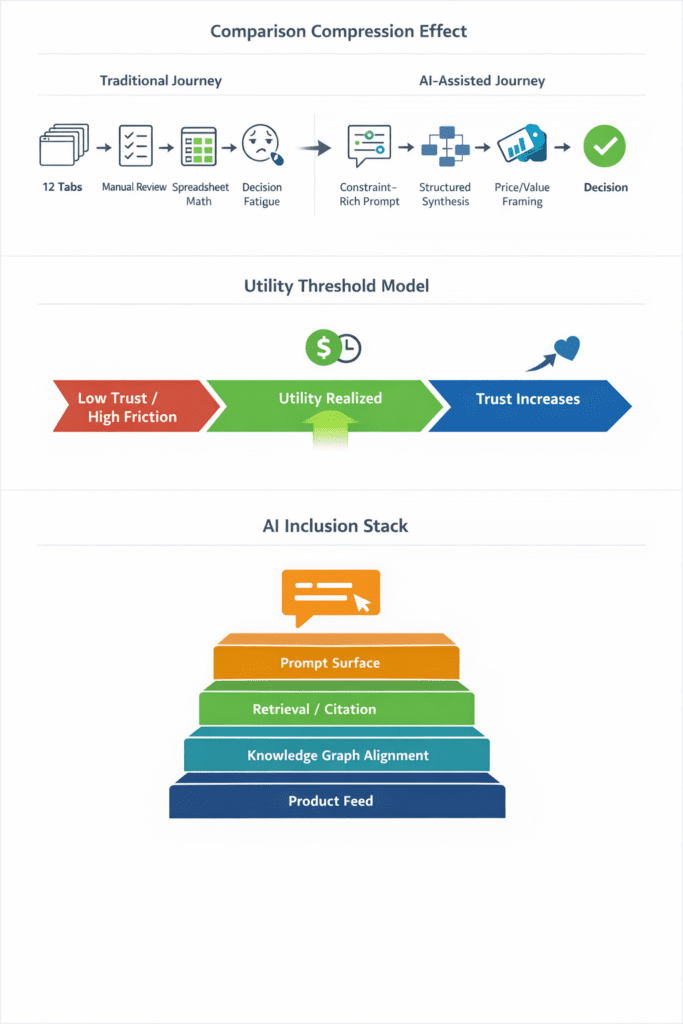
AI compresses time-to-confidence, which is often the real bottleneck in consideration categories.
Troubleshoot and Validate: Post-Discovery Assurance
Even in an AI-first journey, the retailer site remains the place where uncertainty gets resolved. After AI provides a shortlist, consumers commonly shift into validation: confirming specs, comparing variants, checking shipping and return policies, and assessing brand credibility. This is why the retailer’s digital experience is increasingly a risk-reduction surface, not a discovery surface.
Trust concerns don’t stop AI usage; they shape whether AI recommendations translate into transactions. Privacy anxiety, accuracy skepticism, and concerns about bias and disclosure act as “friction multipliers.” If a retailer’s site doesn’t immediately reassure the shopper, through clear policies, unambiguous product information, and visible proof, AI-referred traffic can bounce despite high intent.
Retailers can treat this stage as a conversion engineering problem. The most effective PDPs will reduce redundancy (“don’t make me re-research”) and instead confirm constraints (“meets your requirements”) while surfacing risk reducers (returns, warranties, compatibility, delivery dates).
High-Intent Prompt Taxonomy
Prompt Types That Signal Purchase Intent
In AI-mediated commerce, the keyword is no longer the primary unit of intent. The primary unit is the prompt, and prompts are often richly constrained. They encode budget ceilings, feature requirements, compatibility context, urgency, and comparative framing. This makes them more predictive of purchase proximity than traditional query strings, because they reflect a shopper who has already moved beyond curiosity into evaluation.
For retailers, prompt taxonomy is not an academic exercise, it’s a practical lens for building content and data systems that match how consumers ask. If your feed and PDP content don’t express the attributes and constraints consumers use in prompts, you will miss retrieval opportunities upstream.
Table: AI Prompt Intent Classification Framework
As AI becomes the primary interface for product research, understanding prompt structure is critical. Unlike traditional keyword search, AI prompts often encode layered constraints, price ceilings, feature requirements, compatibility context, and comparative intent. The depth and specificity of these constraints are strong indicators of purchase proximity. The framework below classifies common prompt types by intent density and funnel position.
| Prompt Type | Example | Intent Level | Funnel Stage |
| Open Discovery | “Best gifts for…” | Medium | Discover |
| Attribute-Constrained | “Waterproof trail shoes under $150” | High | Compare |
| Direct Validation | “Is X better than Y?” | High | Validate |
| Price Arbitrage | “Cheapest place to buy…” | Very High | Purchase |
Constraint layering correlates with transactional readiness because it signals that the shopper has defined what “good” looks like.
The Deal-Fatigue Effect as Intent Multiplier
Deal fatigue is a measurable accelerant because it moves shoppers from research to action faster. When consumers feel overwhelmed by promotions and price fragmentation, they become more willing to delegate comparison and arbitrage to AI. That delegation shifts influence upstream: whoever appears in the AI shortlist gains an advantage before the consumer ever opens a marketplace or search results page.
Among younger consumers, this effect is even stronger because platform trust is more flexible and convenience expectations are higher. When AI surfaces a compelling option at a clear value point, it can temporarily override brand inertia, especially for commoditized products.
Diagram: Utility Threshold Model
Low trust / high friction → utility realized → trust increases
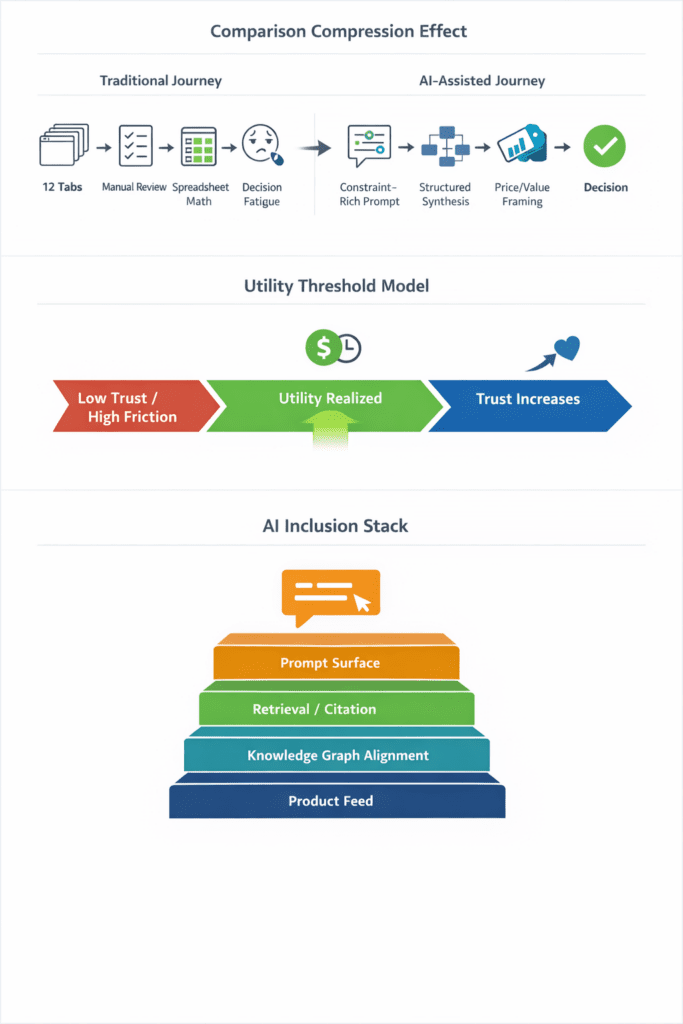
When tangible savings (time or money) are clear, skepticism declines and willingness to transact rises.
Prompt Depth Score
To operationalize prompt taxonomy for SEO/GEO teams, retailers can use a simple internal scoring model that estimates how close a prompt is to purchase based on constraint density.
Table: Prompt Depth Score
Not all prompts carry equal commercial weight. The depth and structure of a shopper’s prompt often reveal how close they are to purchase. By systematically analyzing prompt components, retailers can move beyond anecdotal observations and build measurable intent models. The framework below identifies the core signal types embedded in prompts and explains how they translate into prioritization opportunities across content, feeds, and PDP architecture.
| Signal Type | Examples | Why It Matters |
| Constraint count | budget, size, color, material | More constraints = higher intent |
| Comparatives | “X vs Y”, “better than” | Signals active evaluation |
| Risk reducers | returns, warranty, safety | Signals readiness to buy if risk resolved |
| Context | “for small bathroom”, “DIY beginner” | Guides content + attribute needs |
| Urgency | “this weekend”, “delivery by Friday” | Purchase timing cue |
This is where retailers can go beyond generic AI commentary: by turning prompt patterns into measurable intent models that inform content and feed priorities.
Trust Barriers and Adoption Friction
The Trust-to-Utility Equation
Trust is not a binary gate; it’s a conditional variable. Many consumers will use AI for research even when they have concerns, especially when the utility payoff is high. But trust becomes decisive as the shopper approaches purchase, when money, returns, and data usage feel more consequential.
Practically, AI trust is utility-contingent (does it save time/money?) and transparency-sensitive (do I understand what’s happening?). That means retailers don’t win trust by “claiming” credibility; they win it by making policies, proof, and product details immediately legible.
Table: Trust Drivers vs Trust Inhibitors
| Trust Driver | Enterprise Lever |
| Price transparency | Pricing integrity + clear totals |
| Ease of use | Frictionless UX + fast confirmation |
| Data privacy assurance | Governance clarity + disclosure |
Privacy, Data Use, and Governance Gaps
Consumers increasingly expect transparency about data collection and usage. That expectation creates a new standard: retailers must treat privacy and governance as part of the purchase experience, not as legal fine print.
At the enterprise level, governance maturity often lags adoption. Policies may cover security and privacy at a high level, but gaps remain around explainability, bias, and workforce impact. These gaps matter because they shape the consumer’s perception of whether AI-driven recommendations are trustworthy and fair.
The commercial takeaway is simple: governance is not just compliance, it’s conversion reliability. The retailers with clear disclosure, strong oversight, and consistent policy execution reduce friction at the moment of purchase.
Category-Level Differences in AI Shopping Behavior
AI-Strong Categories
AI influence is strongest in specification-dense categories because the value of synthesis is highest. When products have many comparable attributes (electronics, tools, appliances, beauty routines, home goods), shoppers benefit from structured tradeoff reasoning and compatibility checks. AI performs well here because the “right answer” can be approximated through constraints, reviews, and attribute matching.
For enterprise retailers, these categories are also where structured data has outsized ROI. Clean attributes and consistent taxonomy increase retrieval and recommendation quality, improving both inclusion and conversion.
AI-Weak Categories
AI influence is weaker in identity-driven categories where emotional resonance, brand mythology, and symbolic value dominate. In these segments, the consumer is not just buying features, they’re buying meaning. AI can assist exploration, but the final decision relies more heavily on brand narrative, visual identity, and social proof.
Here, the AI experience itself matters: perceived warmth, human-likeness, and conversational confidence can influence usage, but the retailer still needs to close the loop with storytelling and trust signals.
Table: AI Category Sensitivity Matrix
| Category | Info Density | Emotional Weight | AI Influence |
| Electronics | High | Low | Strong |
| Home Improvement | Medium | Medium | Moderate |
| Luxury | Low | High | Weak |
Implications for SEO, Feeds, and Content Systems
AI as the Discovery Layer Above Search
AI increasingly intercepts discovery before traditional search. That means “visibility” can no longer be defined only by SERP rank. In many categories, the first shortlist is formed in an AI interface, and search becomes a validation step, not the origin.
This reframes SEO into a dual mandate:
- win rankings where they still matter, and
- win inclusion where AI forms consideration sets.
Structured Data and Feed Optimization for Inclusion
AI systems retrieve and synthesize structured relationships: product attributes, taxonomy links, entity descriptors, and review evidence. If your product data is incomplete or inconsistent, the model has less to work with, and your products become less “retrievable” for constrained prompts.
The most practical GEO work is not mystical. It is operational:
- attribute completeness and standardization
- taxonomy normalization (synonyms, units, variant logic)
- reliable availability and pricing signals
- review content mapped to use cases
Diagram: AI Inclusion Stack
Product feed → structured attributes → knowledge graph alignment → retrieval/citation → prompt surface
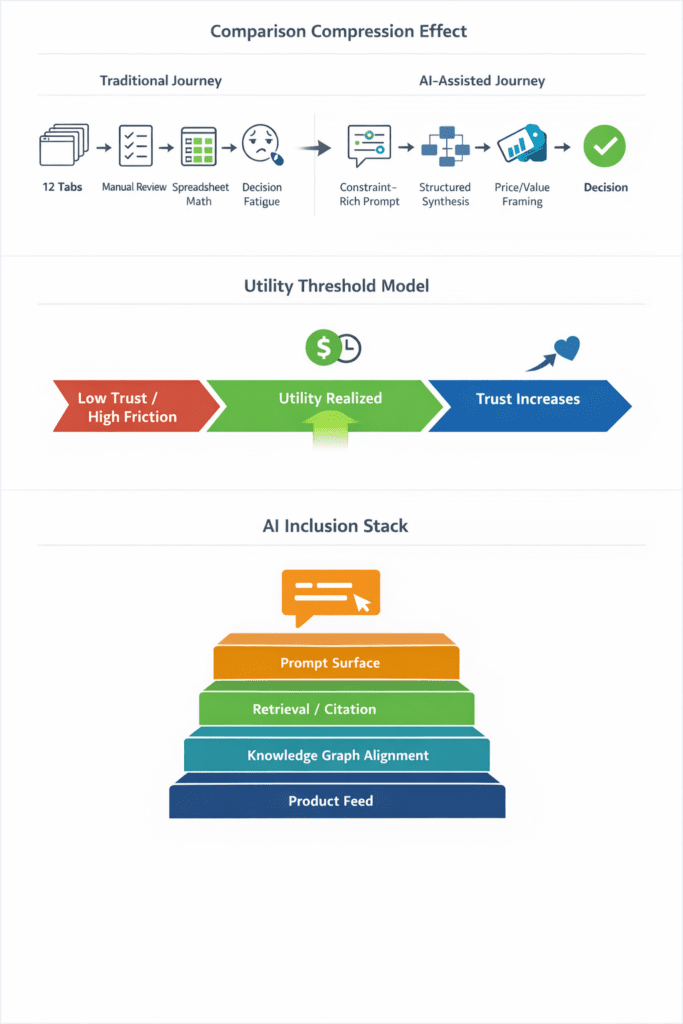
Each layer increases the probability that your SKUs appear in AI shortlists.
PDP Redesign for AI-Primed Traffic
AI-referred shoppers arrive with constraints already formed. They don’t want to browse; they want confirmation. PDPs should therefore mirror prompt logic and reduce the need for re-research.
A practical pattern is the “prompt mirror” module:
- “Meets your constraints” (price, size, compatibility, delivery)
- “Why this vs alternatives” (tradeoff clarity)
- “Risk reducers” (returns, warranty, installation, support)
This is how retailers convert AI-assisted intent: by matching the consumer’s already-made decision frame.
Enterprise Readiness Checklist
AI Adoption vs Impact Gap
Retail adoption is broad, but impact varies because most organizations are still in tool-level augmentation rather than workflow-level redesign. Generative AI is widely deployed in marketing and digital teams because it is easy to pilot and visibly productive. Predictive AI tends to sit in operational functions where data and governance are harder, but ROI can be higher when executed correctly.
The key shift is measuring not “how much AI we use,” but “what manual work AI eliminated” and “what new business outcomes AI created.”
Table: AI Retail Maturity Model
| Stage | Description | Risk |
| Experimentation | Tool pilots | Fragmented ROI |
| Functional AI | Departmental use | Silo effects |
| Operational AI | Workflow embedded | Measurable lift |
| Strategic AI | Operating model integrated | Durable advantage |
Governance and Risk Controls
Governance maturity determines whether AI scales safely and profitably. Retailers often have privacy and security policies, but gaps remain in transparency, explainability, and bias. Those gaps don’t just create regulatory risk, they create consumer trust risk, which shows up as conversion drag.
The best retailers treat governance as product quality: a system that ensures reliability, fairness, and consistency across every AI-mediated interaction.
Measurement Framework: Inclusion Rate and Assisted Revenue
AI Inclusion Rate
AI Inclusion Rate is the percentage of high-intent prompts where your brand or SKU appears in the model’s synthesized response set. It is the AI-era analog to Share of Voice, but it measures presence inside the shortlist rather than presence in ranked results.
This metric matters because inclusion precedes click-through. If you’re not in the synthesized answer, you’re not in the consideration set.
AI-Assisted Revenue Model
Traditional attribution struggles when discovery and comparison occur inside an AI interface. The solution is not to force AI behavior into last-click models; it’s to measure AI influence as a distinct upstream layer that drives downstream conversion.
AI Influence Measurement Stack
To properly quantify AI’s commercial impact, retailers must expand beyond traditional last-click attribution models. When discovery and shortlisting happen inside AI systems, influence occurs upstream of the session. That requires a measurement stack that captures visibility, engagement, and downstream financial performance as distinct but connected layers. The framework below outlines the core metrics enterprises should track to evaluate AI-driven commerce holistically.
| Metric | What it captures | Why it matters |
| Inclusion Rate | Presence in AI shortlists | Visibility before the click |
| AI Clickthrough | Validation-stage engagement | Confirms AI is driving site visits |
| Assisted Revenue | Revenue from AI-origin cohorts | Quantifies financial impact |
| AOV Lift | Basket expansion for AI cohorts | Measures value, not just volume |
| Time-to-Purchase | Cycle compression | Indicates confidence acceleration |
Incrementality and Cannibalization Controls
Incrementality requires separating outcomes by AI type. Predictive AI should be evaluated on operational KPIs (forecast accuracy, inventory turnover, margin impact). Generative AI should be evaluated on customer-facing KPIs (conversion lift, AOV, assisted revenue).
Measurement must also account for the intention-to-use vs use-behavior gap. Effort expectancy drives willingness, but governance clarity, trust signals, and frictionless UX determine whether intent turns into purchase. Without isolating these variables, retailers either over-credit AI for existing demand or under-credit it for influence that occurs upstream.
Conclusion: AI Is Rewriting Entry Points
AI is not replacing retail. It is redefining where retail begins.
As AI becomes habitual for discovery and comparison, the first shortlist increasingly forms outside retailer-owned properties. That changes the competitive game: retailers must win inclusion upstream and close conversion downstream.
The playbook is clear:
- build machine-readable product data
- normalize taxonomy and attributes
- design PDPs for constraint confirmation
- treat governance as conversion infrastructure
- measure inclusion and assisted revenue, not just rankings and traffic
AI is now the front door to commerce. The strategic question is no longer whether consumers will use it. It’s whether your brand will be present when they do.